Liquid Crystal Display(LCD)

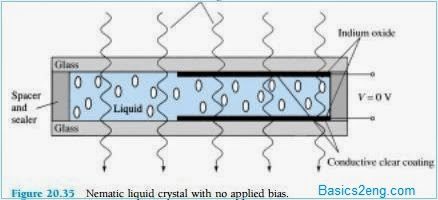
Liquid Crystal Display(LCD):             The liquid crystal display (LCD) has the distinct advantage of having a lower power requirement than the LED.It is typically in the order of microwatts for the display, as compared to the same order of milliwatts for LEDs.It does, however, require an external or internal light source and is … Read more

Oscillators Introduction

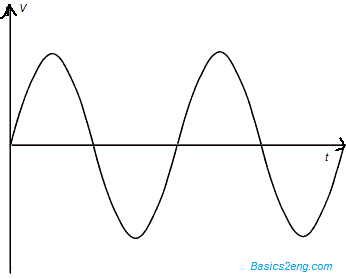
Oscillators Introduction:             An electronic oscillator is an electronic circuit that produces a repetitive, oscillating electronic signal, often a sine wave or a square wave.Oscillators convert direct current (DC) from a power supply to an alternating current signal.They are widely used in many electronic devices.Common examples of signals generated by oscillators include signals broadcast by … Read more

Schottky barrier diode Operation & Characteristics

Schottky Barrier Diode – Operation:             Schottky barrier diode is an extension of the oldest semiconductor device that is the point contact diode.Here, the metal-semiconductor interface is a surface, Schottky barrier rather than a point contact.The Schottky diode is formed when a metal, such as Aluminium, is brought into contact with … Read more

Common Collector Configuration & its characteristics

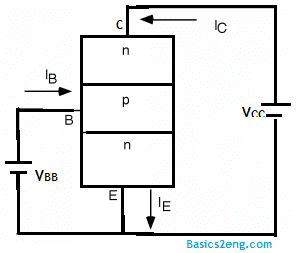
Common Collector Configuration:          The third and final transistor configuration is the common collector configuration, shown in the below figure with the proper current directions and voltage notation.The common collector configuration is used primarily for impedance-matching purposes since it has a high input impedance and low output impedance, opposite to that of the common base … Read more

Common Emitter Configuration & its characteristics

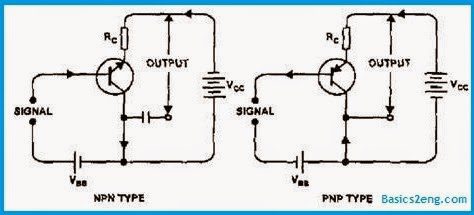
Common Emitter Configuration:            The most frequently encountered transistor configuration appears in Fig. for the PNP and NPN transistors. It is called the common emitter configuration since the emitter is common or reference to both the input and output terminals (in this case common to both the base and collector terminals). Two … Read more

Common Base Configuration & its Characteristics

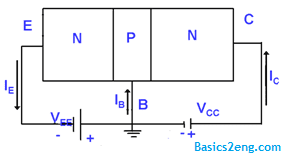
Common Base Configuration:             The notation and symbols used in conjunction with the transistor in the majority of texts and manuals published today are indicated in the figure for the common base configuration with PNP and NPN transistors.The common-base terminology is derived from the fact that the base is common to both … Read more

Class-B Pushpull Amplifier Operation

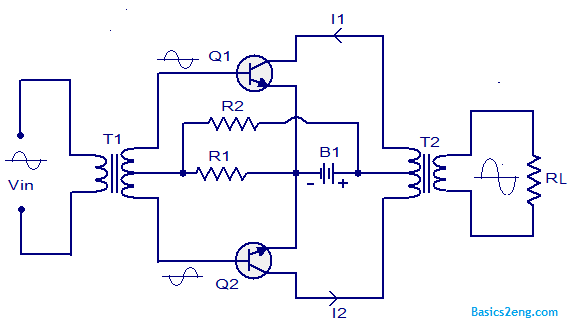
Class-B Pushpull Amplifier Operation: Class–B operation is provided when the dc bias leaves the transistor biased just off, the transistor turning on when the ac signal is applied. This is essentially no bias, and the transistor conducts current for only one-half of the signal cycle. To obtain output for the full cycle of signal, it is necessary to … Read more

Transformer coupled class-A amplifier Operation

Transformer coupled class-A amplifier: Here we will be discussing Transformer coupled class-A amplifier.A form of class A amplifier having a maximum efficiency of 50% uses a transformer to couple the output signal to the load as shown in the below figure. This is a simple circuit form to use in presenting a few basic concepts.More practical circuit … Read more

Series fed Class-A Amplifier Operation

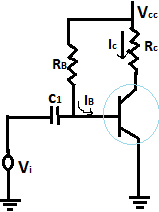
Series fed Class-A Amplifier:       The simple fixed-bias circuit connection shown in the figure below can be used to discuss the main features of a series fed class A amplifier. The only differences between this circuit and the small-signal version considered previously are that the signals handled by the large-signal circuit are in the range of … Read more