Insulating materials used in Underground cables

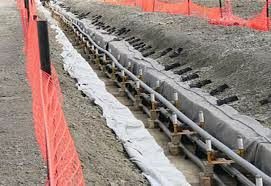
Insulating materials used in Underground cables? In this . I am going you to explain the Insulating materials used in  underground cables.Topics like what type of material is used , where they are laid ,what are the protective measures etc..Lets us start now.The satisfactory operation of a cable depends to a great extent upon the characteristics … Read more

Construction of Underground cables

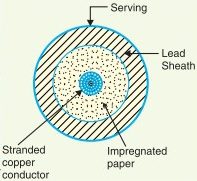
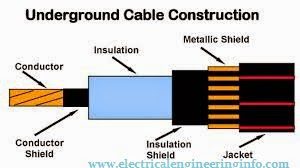
Construction of Underground cables: Hello Mr./Mrs. visitor .First of all thanks for visiting my site.Here I am going you to explain the Construction of Underground cables.Topics like what type of material is used , where they are laid ,what are the protective measures etc..Lets us start now.An underground cable essentially consists of one or more conductors … Read more

Voltage regulation of Alternator using Synchronous Impedance Method or EMF Method

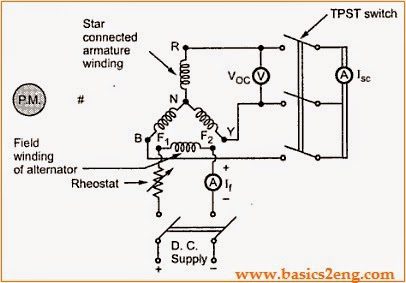
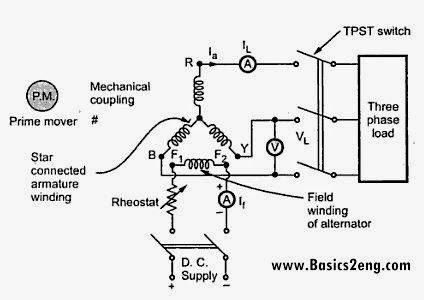
Voltage regulation of synchronous generator using EMF method:          Generally, we use this Synchronous Impedance Method for high-speed Alternators or synchronous generator. This method is also known as EMF method. Before calculating the voltage regulation we need to calculate the following data. 1.Armature Resistance per phase [Ra] 2.Open Circuit characteristics which is a … Read more

Difference between Salient Pole & Cylindrical Pole Rotors in Synchronous Generator

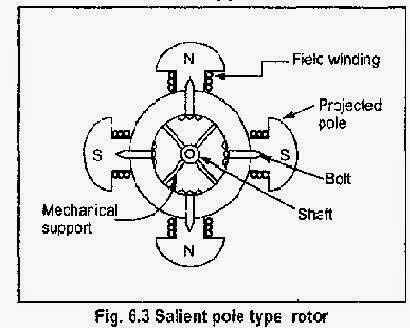
Difference between salient pole & cylindrical pole rotors:           We can define a synchronous generator or alternator as a machine which converts mechanical energy into alternating type electrical energy. It consists of a stator and a rotor. Stator consists of stationary armature windings and rotor consists of fielding winding. The rotor is … Read more

Voltage regulation of synchronous generator [Alternator] using Direct loading method

Voltage regulation of  synchronous generator or Alternator:         The voltage regulation of a synchronous generator[Alternator] can be determined by various methods.In case of small capacity alternators, direct loading test used to determine regulation, while in case of large capacity Alternators Synchronous Impedance method is used.The Synchronous Impedance method has some disadvantages.     … Read more

Principle & working of Synchronous generator or Alternator

Synchronous Generator or Alternator:            It is known that the electric supply used now-a-days for commercial, as well as domestic purposes, is of alternating type.Similar to d.c machines, the a.c machines associated with alternating voltages, are also classified as generators and motors.              Machines generating ac … Read more

Applications of Silicon Controlled Rectifier (SCR)

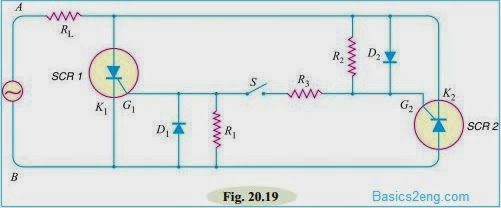
         The ability of an SCR to control large currents in a load by means of small gate current makes this device useful in switching and control applications. Some of the important applications of SCR are discussed below : (i)Application of SCR as static contactor:  An important application of SCR is for switching operations. … Read more

Silicon Controlled Rectifier (SCR) & Construction

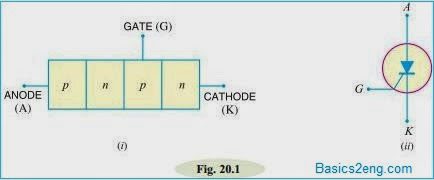
Silicon Controlled Rectifier (SCR):            Silicon controlled rectifier(SCR) is a three-terminal semiconductor switching device which is probably the most important circuit element after the diode and the transistor.Invented in 1957, an SCR can be used as a controlled switch to perform various functions such as rectification, inversion, and regulation of power … Read more

Unijunction Transistor (UJT) & its Construction

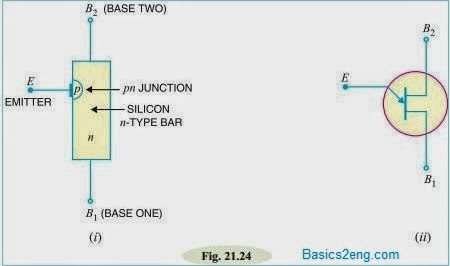
Unijunction Transistor (UJT):        A unijunction transistor (abbreviated as UJT) is a three-terminal semiconductor switching device.This device has a unique characteristic that when it is triggered, the emitter current increases regeneratively until it is limited by emitter power supply.Due to this characteristic, the unijunction transistor can be employed in a variety of applications e.g., switching, … Read more