Retardation Test or Running down Test on DC Machines

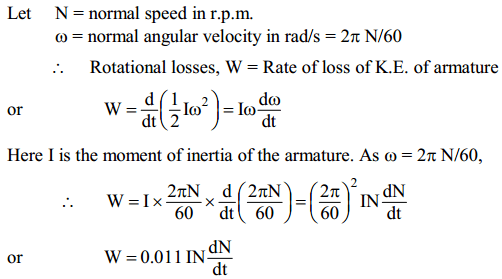
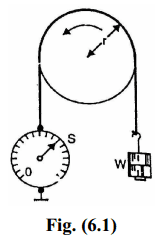
Retardation or Running down Test On dc Machines:     This is the best and simplest method to find the efficiency of a constant-speed dc machine (e.g. shunt generator and motor). In this method, we find the mechanical (friction and windage) and iron losses of the machine. Then knowing the armature and shunt Cu losses at any load, the … Read more

Regenerative or Hopkinson’s test on d.c machines

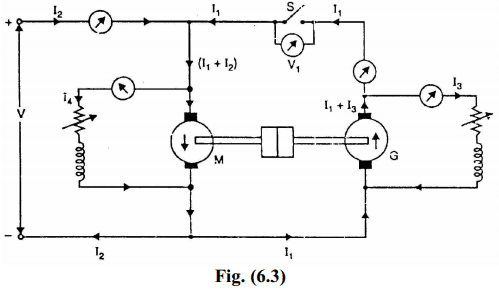
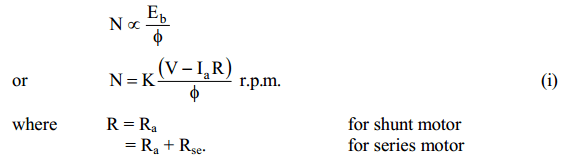
Regenerative or Hopkinson’s test on d.c machines: Regenerative or Hopkinson’s test on dc machines is useful to determine the efficiency which the power.This method of determining the efficiency of a d.c. machine saves power and gives more accurate results. In order to carry out this test, we require two identical d.c. machines and a source of electrical … Read more

Open Circuit & Short Circuit Tests on Transformers

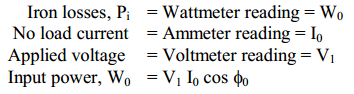
Open Circuit & Short Circuit Tests on Transformers: The circuit constants, efficiency and voltage regulation of a transformer can be determined by two simple tests:  (i) Open-circuit Test  (ii) Short-circuit Test These tests are very convenient as they provide the required information without actually loading the transformer.Further, the power required to carry out these tests is … Read more

Parallel Operation of D.C. Generators

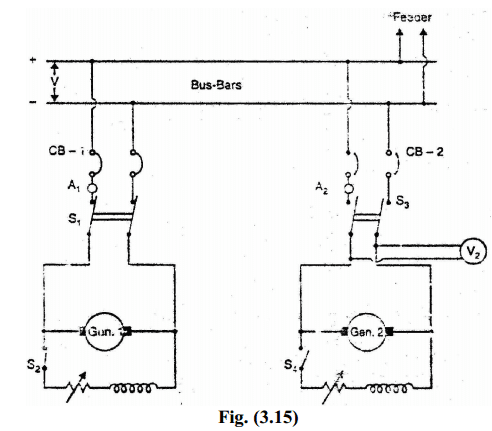
Parallel Operation of D.C. Generators: Here this explains you the parallel operation of dc generators and load sharing among them for the continuous power supply.In a d.c power plant, power is usually supplied from several generators of small ratings connected in parallel instead of from one large generator. This is due to the following reasons: (i) … Read more

Types of Losses in DC Machines

Types of Losses in D.C. Machines: The losses in d.c machines (generator or motor) may be divided into three classes viz  (i) Copper losses  (ii) Iron or core losses   (iii) Mechanical losses All these losses appear as heat and thus raise the temperature of the machine.They also lower the efficiency of the machine.    … Read more